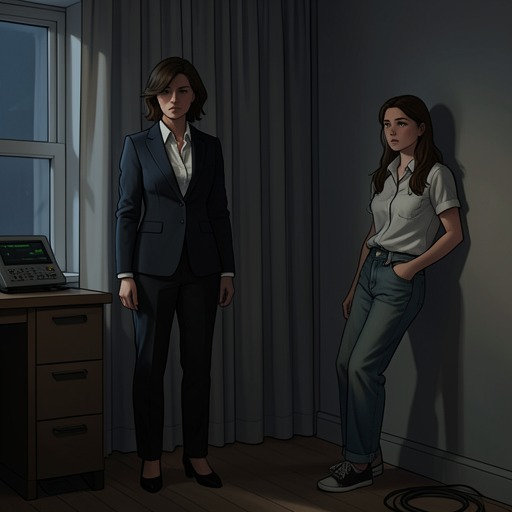
Chris
P.S. I Still Love YouChris is Lara Jean’s close friend, a sharp-tongued presence whose support is expressed less through solemn reassurance than through showing up, asking direct questions, and refusing to let a relationship swallow a friendship. Her appearances place her at Lara Jean’s side during both public embarrassment and private uncertainty, while her humor and independence make her a lively part of the wider circle around Genevieve, Peter Kavinsky, and John Ambrose McClaren.
Identity and Introduction
Chris first registers in Lara Jean’s life through contact: Lara Jean’s phone buzzes with a text from her. Soon afterward, Chris arrives at the Covey home by climbing through a window. Kitty Covey is on the floor with Jamie Fox-Pickle, while Margot Song Covey is contacting Instagram customer service; Chris asks whether Lara Jean is okay. The domestic scene gives her concern a practical form: she enters the space where Lara Jean is, rather than waiting for an account of what has happened.
Her manner is candid and unceremonious. In a later exchange about the hot-tub incident, Chris challenges the idea that a girl’s sexual behavior should make her a target for a degrading judgment. The question turns attention from the girl being discussed to the unfair standard being applied to her. Chris’s role in the scene is not to soften the issue but to name its underlying bias plainly.
Friendship in Action
Chris’s support also includes a readiness to identify blame. When she declares that she knows who is responsible and points to her “she-devil cousin,” her anger is direct and personal. The phrasing conveys her characteristic comic force, but the accusation also places her on Lara Jean’s side in a moment when responsibility for the incident matters. Chris does not treat the episode as harmless gossip; she objects to the harm and looks for its source.
Her friendship with Lara Jean is affectionate as well as protective. When Chris appears at the house with ombré lavender hair, she removes her hood and asks for Lara Jean’s opinion. The small request brings her self-presentation into their friendship: she trusts Lara Jean with a response to a visible change in her appearance. Later, when Chris glares at a woman who has arrived and asks what she is doing there, Lara Jean’s narration makes clear how much she loves Chris. Her loyalty is not depicted as polished agreement; it can be bracing and confrontational.
Chris is equally alert to the time and attention relationships can claim. While she and Lara Jean are spending an afternoon together in Lara Jean’s room, Peter calls and says he is driving by to see whether Lara Jean wants to do something. After Lara Jean agrees to speak with him later, Chris complains that she should not become the kind of person who disappears once she has a relationship. The moment is playful in delivery but serious in its boundary: Chris expects their friendship to remain present, not to be displaced without notice. Her warning makes the cost of romantic absorption visible before the scene turns into a larger conflict.
Place in the Friend Group
Chris’s social character comes into focus during Genevieve’s recurring game of Who Would You Choose. Asked to choose a companion for a deserted island, Lara Jean selects Chris because she would not become bored with her; she also thinks Chris would be more useful there. The choice rests on a particular combination of amusement and competence. Chris, for her part, jokes that Genevieve would choose Trevor Pike because he is obnoxious and substantial enough to be useful if survival became desperate. The group’s teasing shows Chris at ease with comic exaggeration and willing to puncture the game’s earnestness.
The same scene gives Chris a distinct place among the friends. Peter Kavinsky chooses Genevieve because she is his girlfriend, while Lara Jean’s choice of Chris recognizes companionship beyond romance. Chris is also described as someone who could handle herself in a fight, adding capability to the lively, entertaining company Lara Jean values. These details do not make her the center of the group’s romantic history, but they establish her as a memorable participant whose humor and self-possession shape its shared banter.
Change and Narrative Significance
As Lara Jean’s relationship with Peter develops, Chris continues to act as a counterweight to the pull of couplehood. Her objection to Lara Jean going missing is followed, much later in the evidence, by another visit during a period of distress. Chris climbs through Lara Jean’s window wearing a motorcycle jacket and explains that she is supposed to be grounded; she has waited for her mother to fall asleep before going home. She then asks whether Lara Jean is still depressed over Kavinsky. The return to the window echoes her earlier arrival there, making the route itself a sign of persistence: even when constrained by her own household, Chris finds a way to check on her friend.
Chris’s attention to Lara Jean is direct rather than diagnostic. She asks about the sadness, but the evidence does not show her offering a solution or claiming to understand every cause. What it does show is repeated contact: a text, a visit, a blunt question, a shared afternoon, a request for an opinion, and another visit when Lara Jean is struggling. Her narrative significance lies in that recurrence. Around the complications of romance and the tensions of the wider friend group, Chris represents an intimate friendship with its own expectations—one that can tease, challenge, and insist on being remembered.